

Jiva was an agritech company on a mission to improve the livelihoods of 1M+ smallholder farmers across Indonesia and India. Backed by Olam International, Jiva built mobile and field-based services, including crop pricing, harvest procurement, micro-financing, and AI-assisted agronomy advice.
As Product Designer II, I led design for tax transparency and financial workflows, including a compliant tax attribution system for Indonesia's 2022 tax law.
*all figures in IDR (Indonesian Rupiah)
In 2022, new Indonesian tax requirements created a high-stakes product challenge: Jiva needed to correctly attribute tax liability to eligible farmers without damaging trust in the platform.
We redesigned the tax experience to bring tax information into earlier decision-making moments, helping farmers understand what applied, why it applied, and how the amount was calculated.
The system worked across five touchpoints.
Farmers were introduced to the upcoming tax change before enforcement began. This gave them early context before any deductions appeared in their transactions.

Home Screen
The app explained tax rules, NPWP status, and calculation examples in plain language, avoiding formal policy-heavy language that could feel distant or difficult to understand.

Knowledge Base
Tax context appeared inside harvest, trucking, payment, and cost-review flows so farmers could understand when a deduction might apply.

Truck and its cost details after a farmer has booked a truck to transport harvest from farm to feedmill.

Transaction summary after a farmer uploads their harvest data.

Historical inventory of all trucks dispatched by a farmer.
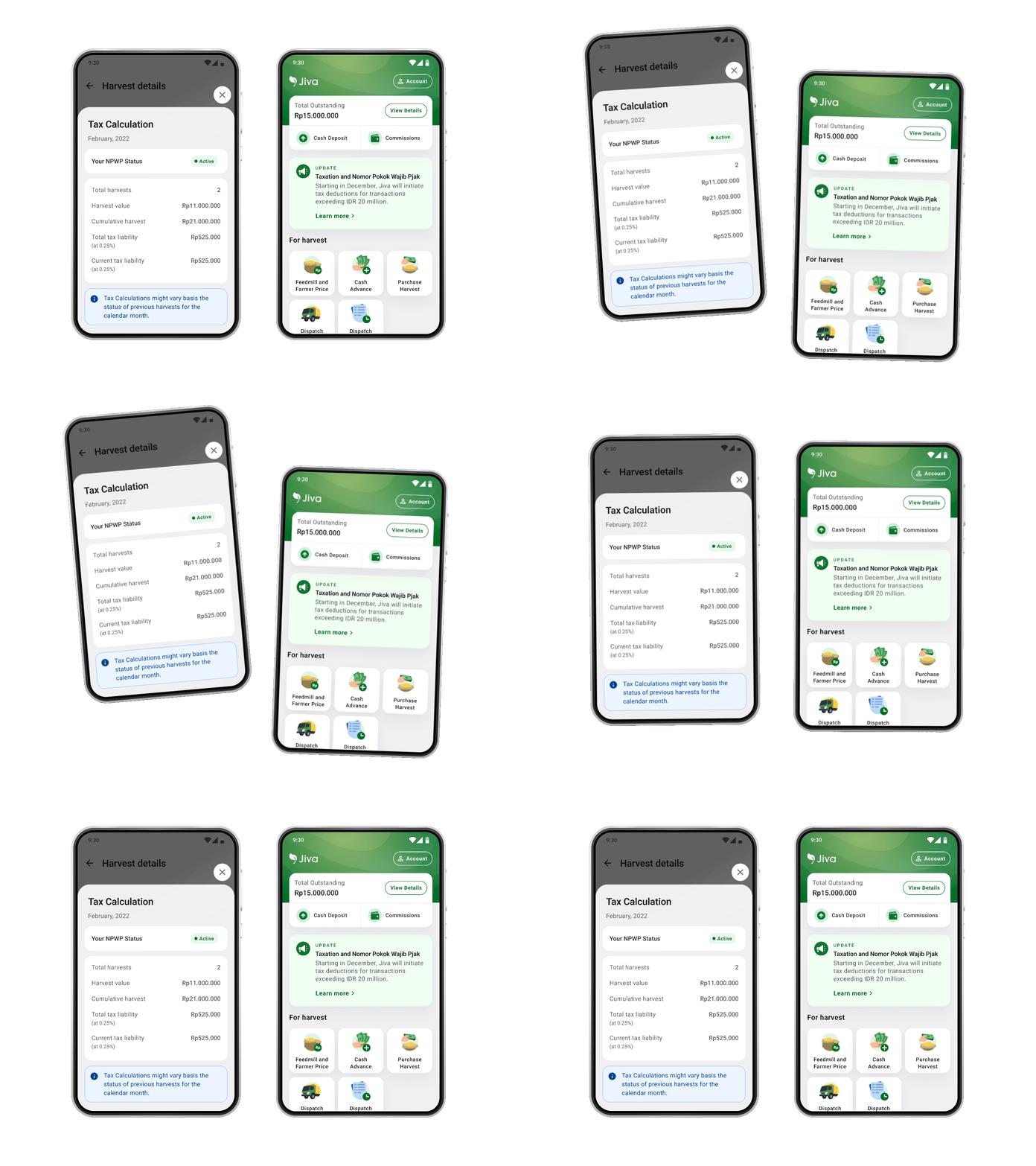
Farmers could see how the amount was calculated through a breakdown of NPWP status, harvest value, cumulative transaction value, tax rate, and current liability.

Breakdown of how Jiva calculates a farmer's tax.
App explanations were aligned with field training, giving Product, Finance, Operations, Training, and Field Teams one shared explanation model.


Before designing, I worked with the research and operations teams to understand how farmers perceived tax, NPWP status, and digital deductions.
We conducted 20 semi-structured interviews across three Indonesian regions: East Java, South Sumatra, and South Sulawesi. Participants were recruited through field teams and represented a wide range of transaction volumes, from under IDR 20M/month to over IDR 1B/month.
Legal language failed in practice.
Farmers skimmed or ignored legal terminology entirely. Long-form policy explanations were not read.

Calculation logic mattered more than policy.
Farmers wanted to understand how a number was derived, not why the policy existed.

NPWP status was poorly understood.
Many farmers didn't realize that an inactive or missing NPWP doubled their tax rate (0.5% vs. 0.25%) but the information had never reached them in actionable form.

Peer explanation > institutional messaging.
Farmers expressed greater confidence when information came from other farmers.

These findings shifted the design problem.
From
"How do we educate users about taxes?"

To
"How do we make tax deductions transparent, verifiable, and emotionally safe?"
Realistic prototypes are an ethical requirement for financial systems.
When money is involved, users are evaluating trustworthiness. Simplified numbers break that evaluation.
Information hierarchy influences trust more than visual polish.
The difference between a confusing deduction and a clear one often came down to when information appeared and how much context preceded it.
Designing for compliance requires attention to emotional safety.
Legal accuracy isn't enough. Farmers needed to feel confident. That required a different kind of clarity, one that respected the anxiety inherent in seeing income reduced.
Product impact compounds when paired with operational support.
The interface and the training sessions weren't separate workstreams. They were two expressions of the same design intent: help farmers face complexity with confidence.